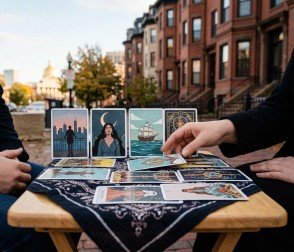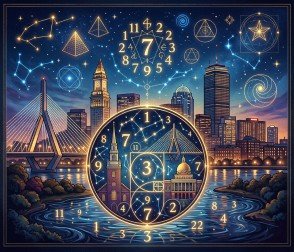
Welcome to Tarot.Boston, your trusted source for daily tarot readings, tarot card meanings, interactive tarot spreads, and insightful spiritual guidance. Whether you are a beginner exploring the world of tarot or an experienced reader seeking deeper understanding, Tarot.Boston offers valuable resources to help you connect with the wisdom of the cards.
Every day, visitors can receive a fresh Daily Tarot Reading designed to provide guidance, inspiration, and perspective for the day ahead. Alongside your daily card, you'll also find today's lucky numbers, adding another layer of insight for reflection, decision-making, and personal growth.
Tarot.Boston features interactive tarot card readings (three card, four card, five card and Celtic Cross readings)that allow you to draw cards online and instantly receive detailed interpretations. Explore popular tarot spreads, discover the meanings of each card in both upright and reversed positions, and learn how tarot symbolism can apply to everyday life.
In addition to readings, our site explores the rich history of tarot, from its origins as a card game in Europe to its modern role as a powerful tool for self-discovery, intuition, and divination. Detailed articles, card explanations, and educational resources make Tarot.Boston an ideal destination for anyone interested in learning tarot.
Visit Tarot.Boston daily for tarot insights, lucky numbers, card meanings, and interactive readings that help illuminate your path and deepen your understanding of the tarot.
 Boston is not a city that wears its mystical dimensions on its sleeve. It presents itself to the world as a place of institutions, of universities, hospitals, law firms, and the kind
of accumulated intellectual authority that comes from three and a half centuries of taking ideas seriously. But beneath that rational, empirical surface runs something considerably older
and considerably less easily categorised: a deep, persistent, genuinely alive relationship with the hidden, the symbolic, and the spiritually significant that has been part of this city's
character from its earliest days.
Boston is not a city that wears its mystical dimensions on its sleeve. It presents itself to the world as a place of institutions, of universities, hospitals, law firms, and the kind
of accumulated intellectual authority that comes from three and a half centuries of taking ideas seriously. But beneath that rational, empirical surface runs something considerably older
and considerably less easily categorised: a deep, persistent, genuinely alive relationship with the hidden, the symbolic, and the spiritually significant that has been part of this city's
character from its earliest days.
The Massachusetts Bay Colony, founded a decade before Boston was formally established, was a community whose entire worldview was saturated with symbolic thinking, with the conviction that the visible world was legible, that events carried meaning beyond their surface appearance, and that the attentive, spiritually serious reader of experience could perceive patterns and purposes invisible to the merely material eye. The Salem witch trials of 1692, though geographically removed from Boston itself, cast a long shadow over the region's relationship with the hidden and the occult, a shadow that was, paradoxically, as much an acknowledgment of how seriously the invisible world was taken as it was a condemnation of those who engaged with it.
Boston's intellectual tradition has always contained within it a powerful counter-current to the purely rational (which can be seen in its Halloween celebrations). The Transcendentalist movement of the nineteenth century, centred in and around the city, drawing its most significant figures from its social and literary circles, was built on the conviction that the material world was a system of symbols pointing toward deeper, more universally significant spiritual truths. Emerson, Thoreau, and their contemporaries were not so distant from the tarot reader's fundamental conviction as the gap in their vocabularies might suggest. Both are engaged in the same essential project: the disciplined, attentive reading of symbol and pattern in the service of genuine human self-understanding.
Today, Boston's relationship with tarot and the broader landscape of symbolic, intuitive, and spiritually alive practices is as rich and as genuinely alive as it has ever been. The city's extraordinary cultural diversity, its Haitian community, its long-established Irish and Italian neighbourhoods, its communities from across Latin America, West Africa, and Southeast Asia, brings to its streets a remarkable breadth of traditions in which divination, symbolic reading, and the consultation of spiritual intelligence are not marginal but genuinely central to the fabric of daily life. Tarot in Boston is not a uniform practice with a single meaning. It is a meeting point for dozens of living traditions, each bringing its own understanding of what it means to seek guidance, to read a sign, and to allow genuine wisdom to arrive through the channel of symbol and image.
For a city that has always, in its most honest and most intellectually serious moments, understood that not everything worth knowing arrives through the purely rational channels, tarot feels less like an import and more like a homecoming. Boston has always known how to read the signs. The cards are simply one more language in which it has always, at its deepest level, been fluent.

The Boston Tarot is the website of Dr. Elliot Voss, an internationally renowned astrologer/astrologist who has been studying the heavens, tarot, and numerology for over forty years.
© Copyright 2025, All Rights Reserved, Elliot Voss | terms & privacy