
The Suit of Swords is one of the four suits of the Minor Arcana in tarot and is most strongly connected to the mind, communication, intellect, truth, and conflict. Associated with the element of air, the Swords cards often explore how people think, make decisions, communicate, and deal with challenges. In tarot readings, this suit frequently points toward mental processes, personal struggles, difficult choices, and the pursuit of clarity and understanding.
The imagery within the Suit of Swords commonly reflects themes of tension, strategy, justice, honesty, and transformation through experience. These cards can represent arguments, emotional pain, anxiety, ambition, moral dilemmas, and the consequences of both words and actions. While the suit is often viewed as one of the more difficult or intense areas of tarot, it also represents intelligence, resilience, problem-solving, and personal growth through adversity.
The numbered cards within the suit trace a symbolic journey beginning with the mental clarity and breakthrough represented by the Ace of Swords and moving through conflict, uncertainty, loss, reflection, and eventual recovery. The court cards, the Page, Knight, Queen, and King of Swords — each represent different expressions of intellectual and communicative energy, ranging from curiosity and directness to wisdom, discipline, logic, and authority.
In tarot readings, the Suit of Swords often appears during periods of decision-making, stress, or significant mental activity. These cards encourage honesty, critical thinking, and awareness of how thoughts and communication shape reality. Whether dealing with conflict, truth, personal responsibility, or emotional struggles, the Suit of Swords represents the power and challenges of the human mind.
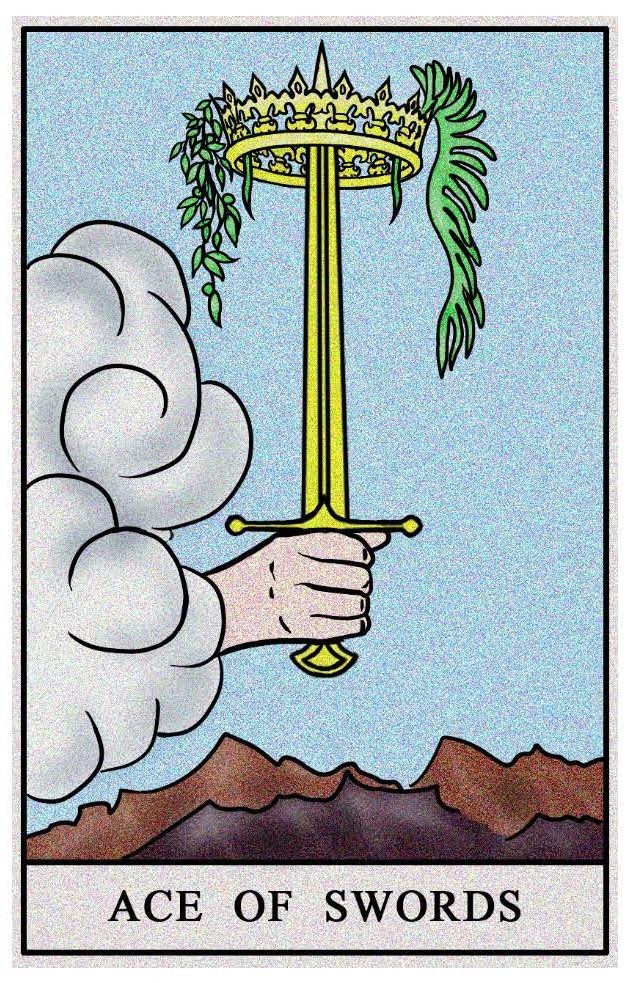 A hand emerges from a cloud, gripping an upright sword whose tip is crowned with a golden wreath and surrounded by yods, the small flame-like symbols of divine energy falling like rain.
The blade is double-edged, as all truth is, capable of cutting through illusion and confusion with equal facility to the way it can wound without wisdom behind it. The sky is clear. The
sword is absolute. Truth, offered here, has no interest in being comfortable. The Ace of Swords is the seed card of the air suit, the element of intellect, communication, conflict, and
the ruthlessly honest mind that perceives things as they are rather than as we might prefer them to be. As an Ace it carries this mental energy in its purest and most undiluted form,
before experience has tempered it with compassion or ego has bent it toward self-serving rationalisation. It is the moment of absolute mental clarity before thought becomes language.
In a reading, the Ace of Swords announces a breakthrough, of clarity, truth, or decisive mental resolution. A situation that has been confused or obscured is suddenly and completely
illuminated. The right words arrive. The truth becomes undeniable. A decision previously impossible to make crystallises with unexpected finality. This card does not promise comfort,
only clarity. And clarity, however sharp its initial edge, is ultimately the greatest gift the mind can offer. Cut through. See clearly. Speak truthfully. Begin.
A hand emerges from a cloud, gripping an upright sword whose tip is crowned with a golden wreath and surrounded by yods, the small flame-like symbols of divine energy falling like rain.
The blade is double-edged, as all truth is, capable of cutting through illusion and confusion with equal facility to the way it can wound without wisdom behind it. The sky is clear. The
sword is absolute. Truth, offered here, has no interest in being comfortable. The Ace of Swords is the seed card of the air suit, the element of intellect, communication, conflict, and
the ruthlessly honest mind that perceives things as they are rather than as we might prefer them to be. As an Ace it carries this mental energy in its purest and most undiluted form,
before experience has tempered it with compassion or ego has bent it toward self-serving rationalisation. It is the moment of absolute mental clarity before thought becomes language.
In a reading, the Ace of Swords announces a breakthrough, of clarity, truth, or decisive mental resolution. A situation that has been confused or obscured is suddenly and completely
illuminated. The right words arrive. The truth becomes undeniable. A decision previously impossible to make crystallises with unexpected finality. This card does not promise comfort,
only clarity. And clarity, however sharp its initial edge, is ultimately the greatest gift the mind can offer. Cut through. See clearly. Speak truthfully. Begin.
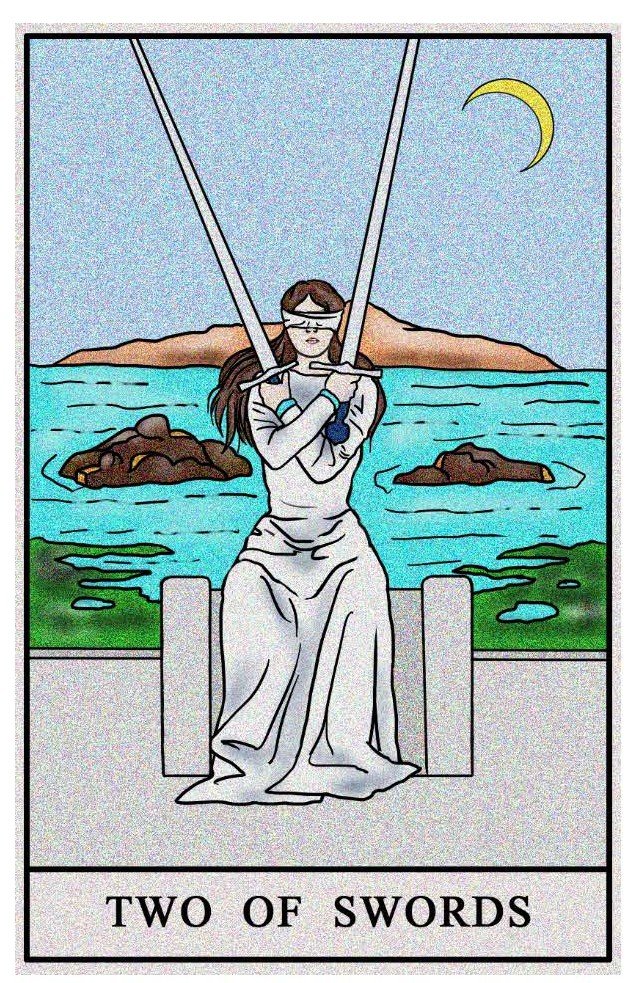 A blindfolded figure sits before a grey sea, arms crossed over their chest, holding two swords in rigid balance, one pointing left, one pointing right. The blindfold is self-imposed.
The sea behind them shifts and moves. The crescent moon illuminates a clouded sky. The figure is not in danger. They are in stalemate, the particular frozen impasse of someone who has
decided that not choosing is safer than choosing wrongly, and who has been sitting in that decision long enough for it to become its own kind of prison. Associated with the Moon in Libra,
the Two of Swords carries the reflective, emotionally sensitive energy of the Moon in the intellectually balanced, decision-averse sign of
Libra, the result being a card of genuine
indecision, deliberate avoidance, and the uncomfortable peace of a mind that refuses to look at what it already, at some level, knows. Libra weighs. The Moon feels. Together they postpone.
In a reading, the Two of Swords points to a decision being deliberately avoided, a truth being deliberately unseen, or an impasse that has solidified through the refusal to engage with
uncomfortable information. The blindfold is yours. Remove it. The information you need to make this decision is available if you are willing to look at it honestly. The longer you sit
in enforced balance, the more the sea behind you shifts and the harder the eventual decision becomes. Choose. The swords will lower when you do.
A blindfolded figure sits before a grey sea, arms crossed over their chest, holding two swords in rigid balance, one pointing left, one pointing right. The blindfold is self-imposed.
The sea behind them shifts and moves. The crescent moon illuminates a clouded sky. The figure is not in danger. They are in stalemate, the particular frozen impasse of someone who has
decided that not choosing is safer than choosing wrongly, and who has been sitting in that decision long enough for it to become its own kind of prison. Associated with the Moon in Libra,
the Two of Swords carries the reflective, emotionally sensitive energy of the Moon in the intellectually balanced, decision-averse sign of
Libra, the result being a card of genuine
indecision, deliberate avoidance, and the uncomfortable peace of a mind that refuses to look at what it already, at some level, knows. Libra weighs. The Moon feels. Together they postpone.
In a reading, the Two of Swords points to a decision being deliberately avoided, a truth being deliberately unseen, or an impasse that has solidified through the refusal to engage with
uncomfortable information. The blindfold is yours. Remove it. The information you need to make this decision is available if you are willing to look at it honestly. The longer you sit
in enforced balance, the more the sea behind you shifts and the harder the eventual decision becomes. Choose. The swords will lower when you do.
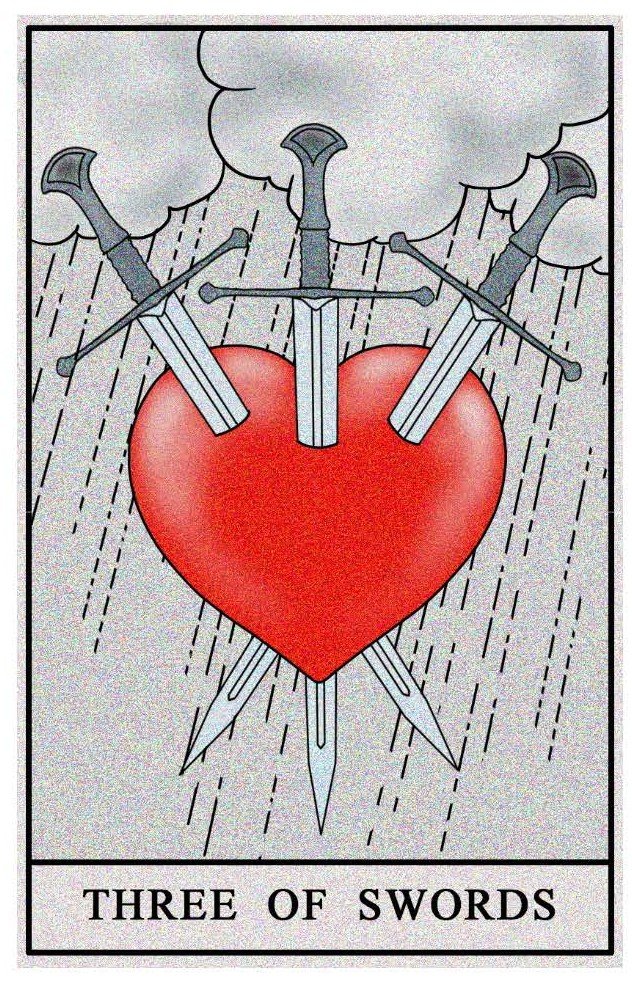 Three swords pierce a red heart directly, cleanly, and without apology, against a backdrop of grey storm clouds and driving rain. There is no figure in this card, no context, no softening
narrative detail, only the heart, the swords, and the rain. It is one of the tarot's most immediately recognisable images precisely because it requires no explanation. Everyone who has ever
loved and lost knows exactly what this card is describing the moment they see it. Associated with Saturn in Libra, the Three of Swords carries the weight of Saturn's inevitable reckoning
expressed through the domain that Libra rules most personally, relationship, partnership, and the particular pain of a love that has been cut by truth, separation, or betrayal. Saturn in
Libra is exalted astrologically, suggesting that even in grief, there is a kind of structural honesty at work here that ultimately serves the soul's growth. In a reading, the Three of Swords
acknowledges heartbreak, grief, separation, and the sorrow that comes from the painful collision of love with hard truth. Your pain is real and it deserves to be felt fully rather than bypassed
or intellectualised away. Yet swords are the suit of the mind and of eventual clarity, even grief, when passed through honestly, ultimately yields understanding. The storm will pass. The heart,
though pierced, is still beating. What has been cut away was perhaps already lost. What remains is real.
Three swords pierce a red heart directly, cleanly, and without apology, against a backdrop of grey storm clouds and driving rain. There is no figure in this card, no context, no softening
narrative detail, only the heart, the swords, and the rain. It is one of the tarot's most immediately recognisable images precisely because it requires no explanation. Everyone who has ever
loved and lost knows exactly what this card is describing the moment they see it. Associated with Saturn in Libra, the Three of Swords carries the weight of Saturn's inevitable reckoning
expressed through the domain that Libra rules most personally, relationship, partnership, and the particular pain of a love that has been cut by truth, separation, or betrayal. Saturn in
Libra is exalted astrologically, suggesting that even in grief, there is a kind of structural honesty at work here that ultimately serves the soul's growth. In a reading, the Three of Swords
acknowledges heartbreak, grief, separation, and the sorrow that comes from the painful collision of love with hard truth. Your pain is real and it deserves to be felt fully rather than bypassed
or intellectualised away. Yet swords are the suit of the mind and of eventual clarity, even grief, when passed through honestly, ultimately yields understanding. The storm will pass. The heart,
though pierced, is still beating. What has been cut away was perhaps already lost. What remains is real.
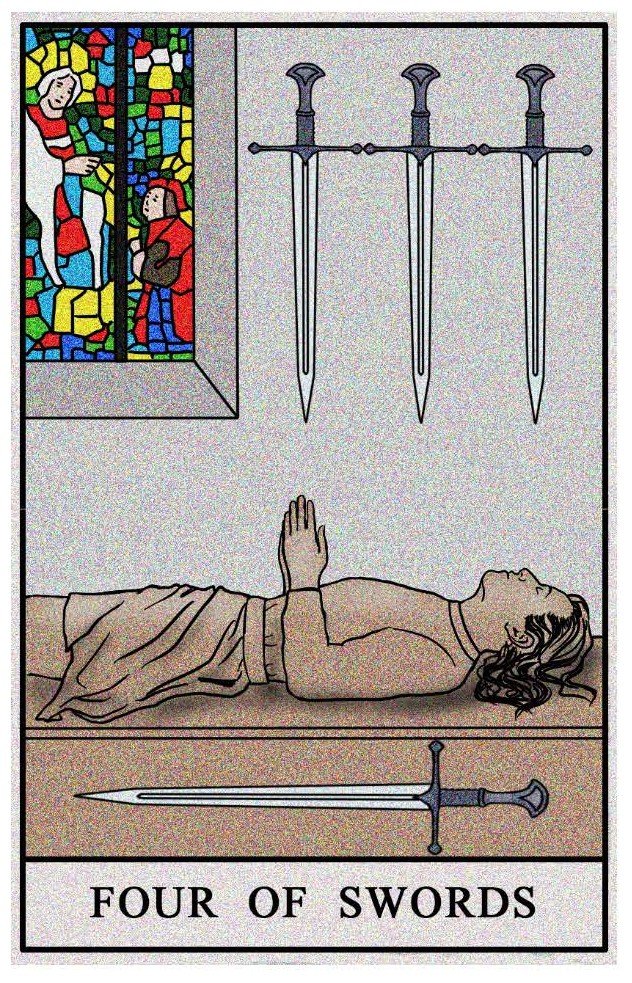 A knight lies in effigy on a stone tomb, hands clasped in the position of prayer, three swords suspended above them on the wall and one beneath them along the tomb's side. Through a stained
glass window, a golden light suggests the world continuing outside. This is not death, the posture is too deliberate, the arrangement too ordered. This is conscious withdrawal, strategic
retreat, the enforced rest of a warrior who knows that the next battle requires preparation the previous one has depleted. Associated with Jupiter in Libra, the Four of Swords brings Jupiter's
philosophical wisdom and capacity for perspective to the airy, mentally active suit of swords, creating a card of deliberate recuperation, mental rest, and the particular wisdom of someone who
understands that stillness is not inaction but a different and equally necessary form of preparation for what lies ahead. In a reading, the Four of Swords is an unambiguous instruction to rest.
Your mind has been working too hard, your nervous system has been pushed beyond its sustainable capacity, and the next phase of your journey requires a level of mental and physical restoration
that busyness categorically cannot provide. Retreat is not defeat. Silence is not surrender. The knight on the tomb will rise again, but only because they allowed themselves to lie down first.
Stop. Breathe. Recover. The world will wait.
A knight lies in effigy on a stone tomb, hands clasped in the position of prayer, three swords suspended above them on the wall and one beneath them along the tomb's side. Through a stained
glass window, a golden light suggests the world continuing outside. This is not death, the posture is too deliberate, the arrangement too ordered. This is conscious withdrawal, strategic
retreat, the enforced rest of a warrior who knows that the next battle requires preparation the previous one has depleted. Associated with Jupiter in Libra, the Four of Swords brings Jupiter's
philosophical wisdom and capacity for perspective to the airy, mentally active suit of swords, creating a card of deliberate recuperation, mental rest, and the particular wisdom of someone who
understands that stillness is not inaction but a different and equally necessary form of preparation for what lies ahead. In a reading, the Four of Swords is an unambiguous instruction to rest.
Your mind has been working too hard, your nervous system has been pushed beyond its sustainable capacity, and the next phase of your journey requires a level of mental and physical restoration
that busyness categorically cannot provide. Retreat is not defeat. Silence is not surrender. The knight on the tomb will rise again, but only because they allowed themselves to lie down first.
Stop. Breathe. Recover. The world will wait.
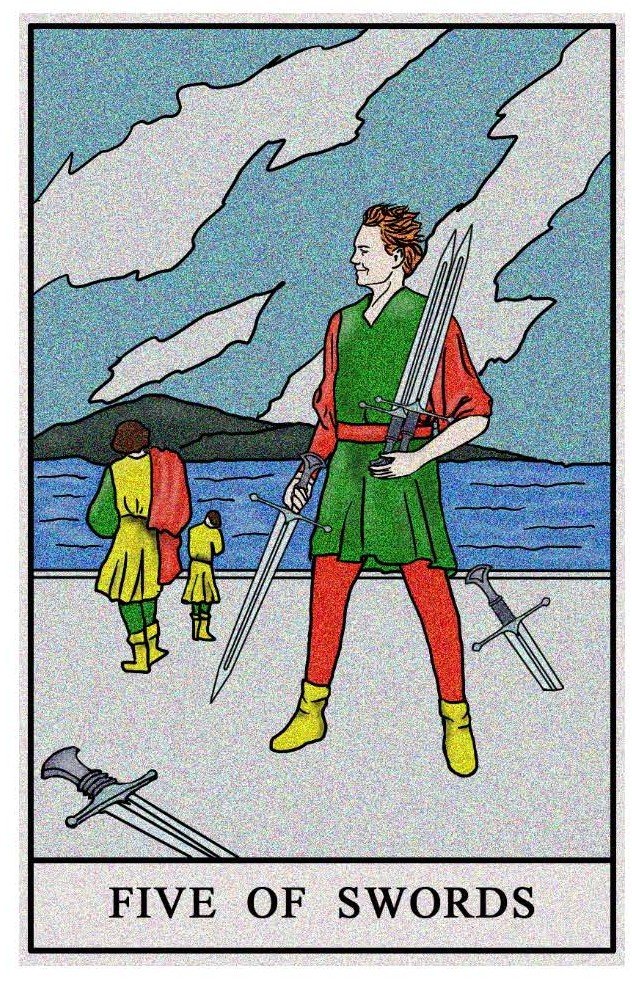 A smirking figure gathers three swords from the ground Whilst two dejected figures walk away in the distance, their own swords abandoned. Two more swords remain at the victorious figure's feet.
The sky is turbulent and torn. Someone has won this conflict, but look at the winner's expression and the landscape left behind and ask yourself honestly: what, exactly, has been won here, and at
what cost to all involved, including the victor? Associated with Venus in Aquarius, the Five of Swords carries the tension between Venus's instinct for harmony, beauty, and genuine connection and
Aquarius's cool, detached, ideologically driven approach to human interaction, the result being the card of the hollow victory, the conflict won through means that damage the relationship it was
supposed to resolve, and the particular emptiness of being right in a way that leaves everyone, including yourself, diminished. In a reading, the Five of Swords asks you to examine the cost of
the conflict you are engaged in, or the victory you are pursuing. Winning at all costs is a strategy with costs that are not always apparent until after the battle is over. Is this fight worth what
it is taking from you and from those around you? Sometimes the wisest sword stroke is the one that sheathes the blade entirely. Examine your motivations honestly. Not every battle that can be won
should be fought to its conclusion.
A smirking figure gathers three swords from the ground Whilst two dejected figures walk away in the distance, their own swords abandoned. Two more swords remain at the victorious figure's feet.
The sky is turbulent and torn. Someone has won this conflict, but look at the winner's expression and the landscape left behind and ask yourself honestly: what, exactly, has been won here, and at
what cost to all involved, including the victor? Associated with Venus in Aquarius, the Five of Swords carries the tension between Venus's instinct for harmony, beauty, and genuine connection and
Aquarius's cool, detached, ideologically driven approach to human interaction, the result being the card of the hollow victory, the conflict won through means that damage the relationship it was
supposed to resolve, and the particular emptiness of being right in a way that leaves everyone, including yourself, diminished. In a reading, the Five of Swords asks you to examine the cost of
the conflict you are engaged in, or the victory you are pursuing. Winning at all costs is a strategy with costs that are not always apparent until after the battle is over. Is this fight worth what
it is taking from you and from those around you? Sometimes the wisest sword stroke is the one that sheathes the blade entirely. Examine your motivations honestly. Not every battle that can be won
should be fought to its conclusion.
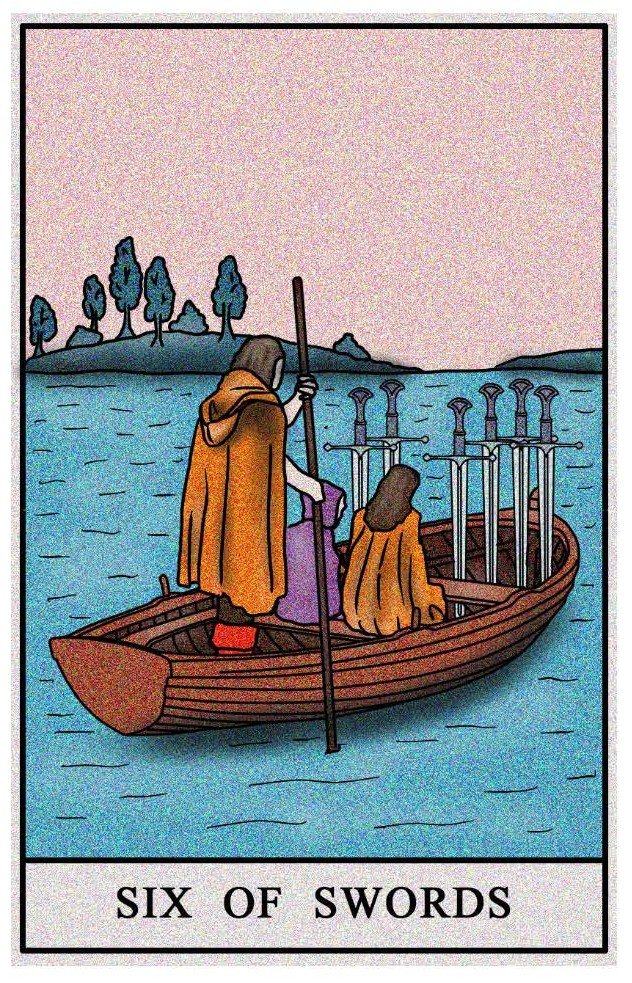 A figure poles a small boat across calm water, carrying a passenger, perhaps a child, huddled beneath a cloak among six upright swords. The water on the left side of the boat is choppy and disturbed;
on the right, it is glassy and still. They are moving away from turbulence toward calmer waters. The destination is not yet visible, but the direction is clear and the movement is steady and purposeful.
Passage is being made. Something difficult is being left behind. Associated with Mercury in Aquarius, the Six of Swords combines Mercury's navigational intelligence and communicative clarity with
Aquarius's forward-looking, future-oriented perspective to create the card of the rational, necessary transition, the movement away from a painful situation toward one that, Whilst not yet fully
formed, is unmistakably calmer, healthier, and more aligned with the person you are in the process of becoming. In a reading, the Six of Swords speaks of transition, passage, and the gentle but
irreversible movement away from difficulty toward calmer ground. You may not be fully healed. The destination may not be entirely clear. But you are moving in the right direction and the water ahead
is undeniably smoother than the water behind. Allow yourself to be carried. Trust the ferryman of your own quiet, persistent good sense. The far shore exists. You are already on your way to it.
A figure poles a small boat across calm water, carrying a passenger, perhaps a child, huddled beneath a cloak among six upright swords. The water on the left side of the boat is choppy and disturbed;
on the right, it is glassy and still. They are moving away from turbulence toward calmer waters. The destination is not yet visible, but the direction is clear and the movement is steady and purposeful.
Passage is being made. Something difficult is being left behind. Associated with Mercury in Aquarius, the Six of Swords combines Mercury's navigational intelligence and communicative clarity with
Aquarius's forward-looking, future-oriented perspective to create the card of the rational, necessary transition, the movement away from a painful situation toward one that, Whilst not yet fully
formed, is unmistakably calmer, healthier, and more aligned with the person you are in the process of becoming. In a reading, the Six of Swords speaks of transition, passage, and the gentle but
irreversible movement away from difficulty toward calmer ground. You may not be fully healed. The destination may not be entirely clear. But you are moving in the right direction and the water ahead
is undeniably smoother than the water behind. Allow yourself to be carried. Trust the ferryman of your own quiet, persistent good sense. The far shore exists. You are already on your way to it.
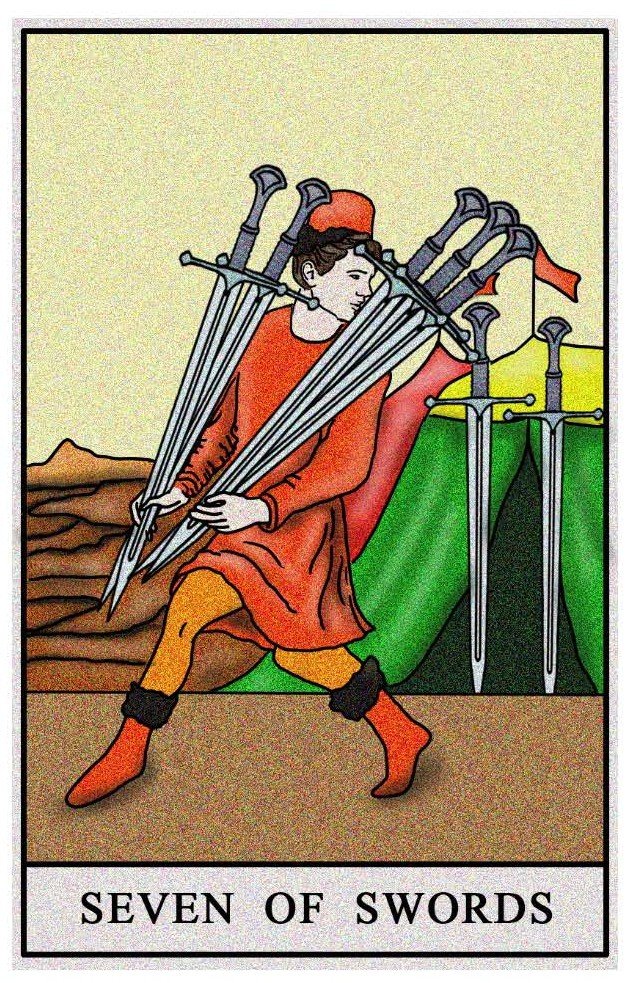 A figure tiptoes away from a military encampment carrying five swords, glancing back over one shoulder with a sly, self-satisfied expression. Two swords remain planted in the ground behind them. The
camp is unaware of the departure. Whether this is a strategic withdrawal, a clever escape, or an act of theft and betrayal depends entirely on who the figure is, where their loyalties lie, and what
story surrounds the taking of those swords. Context, this card insists, is everything. Associated with the Moon in Aquarius, the Seven of Swords brings the Moon's instinct for self-preservation and
emotional self-protection into the cool, individualistic, sometimes iconoclastic territory of Aquarius, producing the card of the lone operator, the strategic thinker who plays by their own rules,
and the person who believes that the ends justify whatever means are required to achieve them, regardless of what conventional morality might prefer. In a reading, the Seven of Swords may indicate
deception, by you, toward you, or within a situation you are navigating. It may also speak of the need for strategic thinking, diplomacy, and the wisdom of not revealing your entire hand at once.
Examine the situation honestly: is a tactical approach serving genuine necessity, or has clever strategy drifted into something that compromises your integrity? Not all stealth is dishonest. But all
dishonesty, eventually, leaves two swords behind as evidence.
A figure tiptoes away from a military encampment carrying five swords, glancing back over one shoulder with a sly, self-satisfied expression. Two swords remain planted in the ground behind them. The
camp is unaware of the departure. Whether this is a strategic withdrawal, a clever escape, or an act of theft and betrayal depends entirely on who the figure is, where their loyalties lie, and what
story surrounds the taking of those swords. Context, this card insists, is everything. Associated with the Moon in Aquarius, the Seven of Swords brings the Moon's instinct for self-preservation and
emotional self-protection into the cool, individualistic, sometimes iconoclastic territory of Aquarius, producing the card of the lone operator, the strategic thinker who plays by their own rules,
and the person who believes that the ends justify whatever means are required to achieve them, regardless of what conventional morality might prefer. In a reading, the Seven of Swords may indicate
deception, by you, toward you, or within a situation you are navigating. It may also speak of the need for strategic thinking, diplomacy, and the wisdom of not revealing your entire hand at once.
Examine the situation honestly: is a tactical approach serving genuine necessity, or has clever strategy drifted into something that compromises your integrity? Not all stealth is dishonest. But all
dishonesty, eventually, leaves two swords behind as evidence.
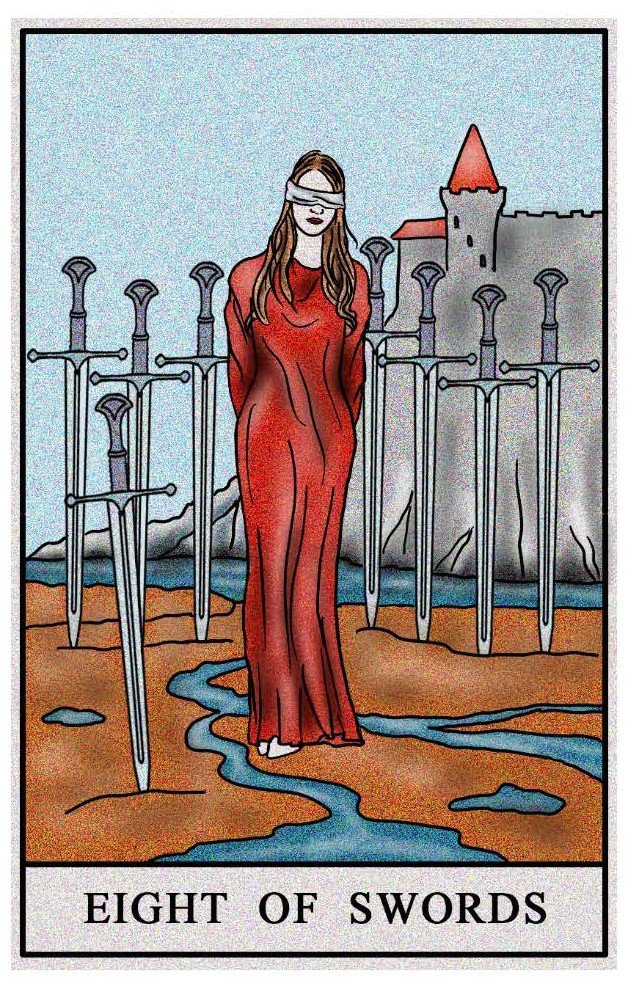 A figure stands bound and blindfolded, surrounded by eight swords planted in the earth around them in a loose encirclement. Yet the binding is not tight, the swords do not touch them, and the ground
beneath their feet is clear. They could walk out of this situation. The blindfold prevents them from seeing that the cage is largely of their own construction, assembled from fear, from limiting belief,
from the stories they have told themselves about what is and is not possible for them. Associated with Jupiter in Gemini, the Eight of Swords carries the tension between Jupiter's expansive, freedom-seeking
optimism and Gemini's tendency toward mental hyperactivity, self-contradiction, and the anxious over-thinking that can trap an otherwise agile mind in a web of its own manufacture. Jupiter here wants to
expand; Gemini's shadow keeps the mind too busy with its own noise to notice the clear path that expansion would take. In a reading, the Eight of Swords speaks with compassionate directness about self-imposed
limitation, paralysing fear, and the stories you are telling yourself about why freedom, change, or a better situation is not available to you. The prison is largely mental. The swords are real but they
are not touching you. The binding is real but it is not unbreakable. Remove the blindfold of your own fearful thinking and look clearly at your situation. The way out has been there all along. You simply
needed to be willing to see it.
A figure stands bound and blindfolded, surrounded by eight swords planted in the earth around them in a loose encirclement. Yet the binding is not tight, the swords do not touch them, and the ground
beneath their feet is clear. They could walk out of this situation. The blindfold prevents them from seeing that the cage is largely of their own construction, assembled from fear, from limiting belief,
from the stories they have told themselves about what is and is not possible for them. Associated with Jupiter in Gemini, the Eight of Swords carries the tension between Jupiter's expansive, freedom-seeking
optimism and Gemini's tendency toward mental hyperactivity, self-contradiction, and the anxious over-thinking that can trap an otherwise agile mind in a web of its own manufacture. Jupiter here wants to
expand; Gemini's shadow keeps the mind too busy with its own noise to notice the clear path that expansion would take. In a reading, the Eight of Swords speaks with compassionate directness about self-imposed
limitation, paralysing fear, and the stories you are telling yourself about why freedom, change, or a better situation is not available to you. The prison is largely mental. The swords are real but they
are not touching you. The binding is real but it is not unbreakable. Remove the blindfold of your own fearful thinking and look clearly at your situation. The way out has been there all along. You simply
needed to be willing to see it.
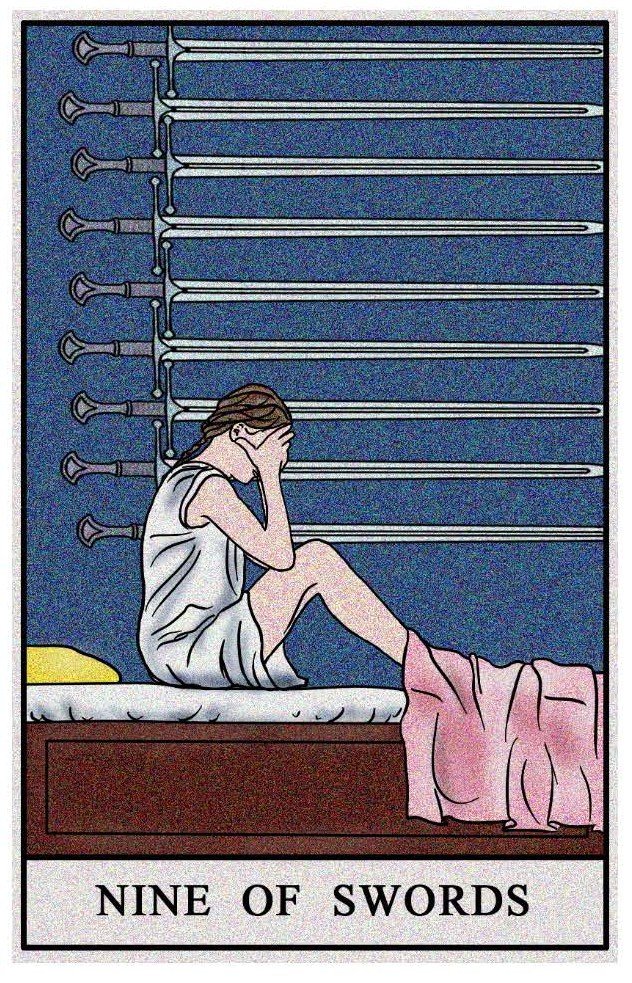 A figure sits bolt upright in bed, head in hands, in the darkest hour of the night. Nine swords hang horizontally on the wall behind them, not threatening, simply present, like the thoughts that have
just driven them from sleep. A carved panel at the foot of the bed shows one figure defeating another. A quilt patterned with roses and astrological symbols covers them. The room is safe. The terror is
entirely internal. The night mind has been at work again. Associated with Mars in Gemini, the Nine of Swords carries the agitating, restless, and combative energy of Mars in the hyperactive, mentally voracious
sign of Gemini, producing the card of anxiety, sleeplessness, and the particular torment of a mind that cannot stop generating worst-case scenarios, revisiting past failures, and catastrophising futures that
have not yet arrived and may never do so. In a reading, the Nine of Swords acknowledges the very real suffering of anxiety, depression, guilt, and the 3am variety of mental anguish that feels absolutely true
in the moment and absolutely unsolvable in the dark. Your distress is genuine and deserves compassion, not dismissal. But swords are the suit of the mind, and what the mind creates, the mind can, with help
and time and honest examination, also begin to release. Morning exists. Seek it. Speak to someone. The nine swords are thoughts, not facts.
A figure sits bolt upright in bed, head in hands, in the darkest hour of the night. Nine swords hang horizontally on the wall behind them, not threatening, simply present, like the thoughts that have
just driven them from sleep. A carved panel at the foot of the bed shows one figure defeating another. A quilt patterned with roses and astrological symbols covers them. The room is safe. The terror is
entirely internal. The night mind has been at work again. Associated with Mars in Gemini, the Nine of Swords carries the agitating, restless, and combative energy of Mars in the hyperactive, mentally voracious
sign of Gemini, producing the card of anxiety, sleeplessness, and the particular torment of a mind that cannot stop generating worst-case scenarios, revisiting past failures, and catastrophising futures that
have not yet arrived and may never do so. In a reading, the Nine of Swords acknowledges the very real suffering of anxiety, depression, guilt, and the 3am variety of mental anguish that feels absolutely true
in the moment and absolutely unsolvable in the dark. Your distress is genuine and deserves compassion, not dismissal. But swords are the suit of the mind, and what the mind creates, the mind can, with help
and time and honest examination, also begin to release. Morning exists. Seek it. Speak to someone. The nine swords are thoughts, not facts.
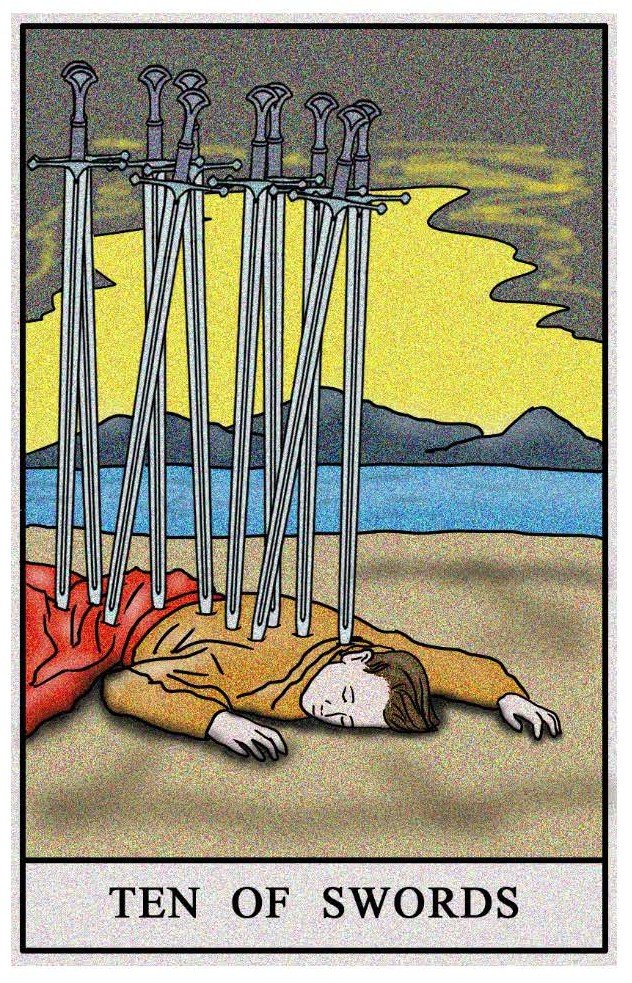 A figure lies face down on the ground, ten swords planted in their back, beneath a sky that is pitch black at the top but lit with the golden light of a new dawn at the horizon. One hand is raised slightly
in a gesture that may be farewell or may be the last reach toward something. This is the card of total, absolute, dramatic defeat, the rock bottom, the ending that could not be more definitive. And yet: the
dawn. It is always there in this card. The dawn is always there. Associated with the Sun in Gemini, the Ten of Swords carries the life-giving vitality of the Sun into the final and most painful station of
the air suit, creating the paradox of a card that represents maximum suffering illuminated by the certain promise of renewal. The Sun in Gemini does not dwell in any one state permanently, its nature is to
move, to communicate, to connect, and eventually to rise again. In a reading, the Ten of Swords announces an ending, painful, definitive, and non-negotiable. Something is over. Fighting it or denying it
only prolongs the suffering without changing the outcome. Accept the ending with as much grace as you can summon. Then look at the horizon of this card, because the light there is real and it is for you.
Endings this complete contain within them the seed of beginnings equally complete. The worst is over. The dawn is not a metaphor. It is the next thing.
A figure lies face down on the ground, ten swords planted in their back, beneath a sky that is pitch black at the top but lit with the golden light of a new dawn at the horizon. One hand is raised slightly
in a gesture that may be farewell or may be the last reach toward something. This is the card of total, absolute, dramatic defeat, the rock bottom, the ending that could not be more definitive. And yet: the
dawn. It is always there in this card. The dawn is always there. Associated with the Sun in Gemini, the Ten of Swords carries the life-giving vitality of the Sun into the final and most painful station of
the air suit, creating the paradox of a card that represents maximum suffering illuminated by the certain promise of renewal. The Sun in Gemini does not dwell in any one state permanently, its nature is to
move, to communicate, to connect, and eventually to rise again. In a reading, the Ten of Swords announces an ending, painful, definitive, and non-negotiable. Something is over. Fighting it or denying it
only prolongs the suffering without changing the outcome. Accept the ending with as much grace as you can summon. Then look at the horizon of this card, because the light there is real and it is for you.
Endings this complete contain within them the seed of beginnings equally complete. The worst is over. The dawn is not a metaphor. It is the next thing.
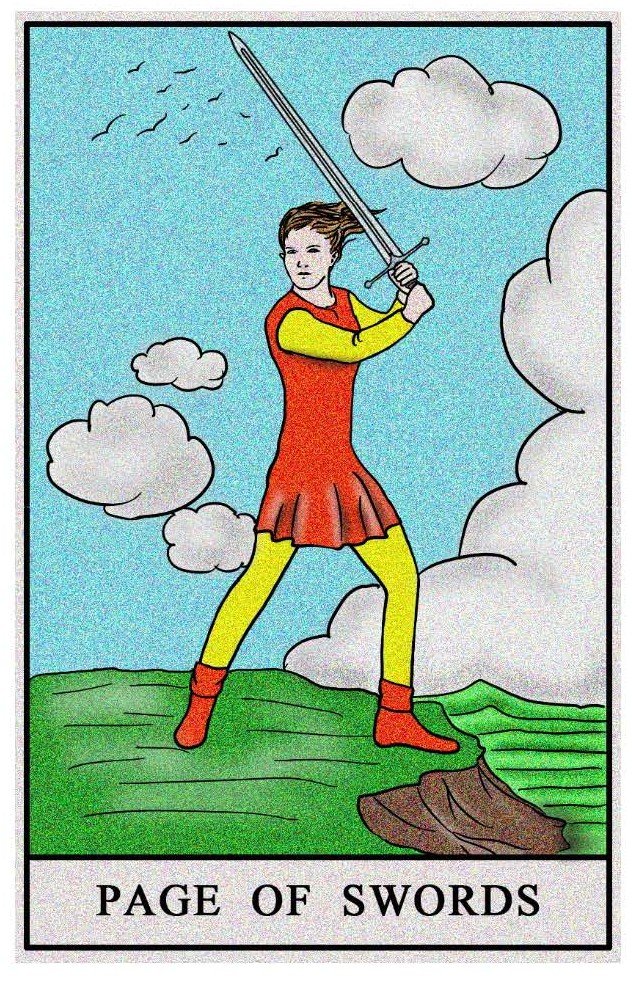 A young figure stands on a windswept hilltop, sword raised and held in both hands at an alert, watchful angle, hair and clothing streaming in the wind. They are scanning the horizon with sharp, intelligent
eyes, not looking for trouble exactly, but entirely prepared for it should it arrive, and more than a little hoping that something interesting enough to engage their formidable mental energy will appear on
the horizon soon. This Page is ready for anything. As the earth element of the air suit, the Page of Swords grounds the mental agility and communicative sharpness of the sword energy in a young, curious, and
practically alert way, bringing news and messages from the realm of intellect and conflict with the quick-witted, observant attentiveness of someone whose mind is always on, always processing, and always several
steps ahead of the conversation. In a reading, the Page of Swords may represent a young person of sharp intelligence, quick wit, and probing curiosity who brings important information, or a pointed question,
into your life. As an energy within yourself, they call you toward intellectual alertness, the honest asking of difficult questions, and the willingness to challenge assumptions, including your own. Be curious.
Be direct. Be willing to speak the thing that others are tactfully declining to say. The Page of Swords has never found a truth too uncomfortable to pursue.
A young figure stands on a windswept hilltop, sword raised and held in both hands at an alert, watchful angle, hair and clothing streaming in the wind. They are scanning the horizon with sharp, intelligent
eyes, not looking for trouble exactly, but entirely prepared for it should it arrive, and more than a little hoping that something interesting enough to engage their formidable mental energy will appear on
the horizon soon. This Page is ready for anything. As the earth element of the air suit, the Page of Swords grounds the mental agility and communicative sharpness of the sword energy in a young, curious, and
practically alert way, bringing news and messages from the realm of intellect and conflict with the quick-witted, observant attentiveness of someone whose mind is always on, always processing, and always several
steps ahead of the conversation. In a reading, the Page of Swords may represent a young person of sharp intelligence, quick wit, and probing curiosity who brings important information, or a pointed question,
into your life. As an energy within yourself, they call you toward intellectual alertness, the honest asking of difficult questions, and the willingness to challenge assumptions, including your own. Be curious.
Be direct. Be willing to speak the thing that others are tactfully declining to say. The Page of Swords has never found a truth too uncomfortable to pursue.
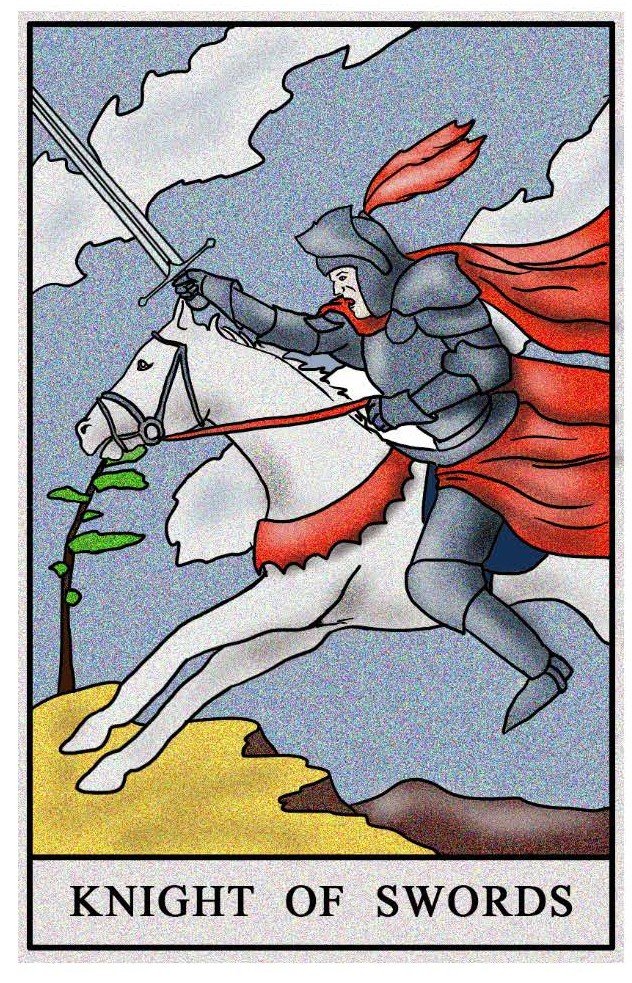 A knight on a charging white horse hurtles forward into a storm, sword raised, cape streaming behind them, trees bending violently in the gale. Everything about this image is speed, force, and absolute commitment
to forward motion. There is no hesitation in this charge, no second-guessing, no holding back for the sake of anyone or anything standing in the path. Whether or not the cause is worth the charge, this Knight has
already committed to finding out at full gallop. As the
fire element of the air suit, the Knight of Swords brings passionate, driving, impulsive fire energy into the intellectual and communicative domain of air,
producing the most dramatically forceful and potentially reckless card in the entire deck. Associated with the sign of Gemini and the drive of Mars, he is brilliant, fast, decisive, and entirely capable of winning
the argument, winning the battle, and then realising too late that he has not considered what winning actually costs. In a reading, the Knight of Swords signals rapid, forceful movement, a situation accelerating
beyond the point where measured reflection is available, a person arriving with ideas or conflict at a speed that demands immediate engagement. As an energy within yourself, he is the courage to charge forward with
intellectual conviction and passionate certainty. But heed the caution embedded in his image: look at what you are charging toward before the horse reaches full speed. Brilliant momentum in the wrong direction is
still the wrong direction. Choose your battles. Then ride as hard as you like.
A knight on a charging white horse hurtles forward into a storm, sword raised, cape streaming behind them, trees bending violently in the gale. Everything about this image is speed, force, and absolute commitment
to forward motion. There is no hesitation in this charge, no second-guessing, no holding back for the sake of anyone or anything standing in the path. Whether or not the cause is worth the charge, this Knight has
already committed to finding out at full gallop. As the
fire element of the air suit, the Knight of Swords brings passionate, driving, impulsive fire energy into the intellectual and communicative domain of air,
producing the most dramatically forceful and potentially reckless card in the entire deck. Associated with the sign of Gemini and the drive of Mars, he is brilliant, fast, decisive, and entirely capable of winning
the argument, winning the battle, and then realising too late that he has not considered what winning actually costs. In a reading, the Knight of Swords signals rapid, forceful movement, a situation accelerating
beyond the point where measured reflection is available, a person arriving with ideas or conflict at a speed that demands immediate engagement. As an energy within yourself, he is the courage to charge forward with
intellectual conviction and passionate certainty. But heed the caution embedded in his image: look at what you are charging toward before the horse reaches full speed. Brilliant momentum in the wrong direction is
still the wrong direction. Choose your battles. Then ride as hard as you like.
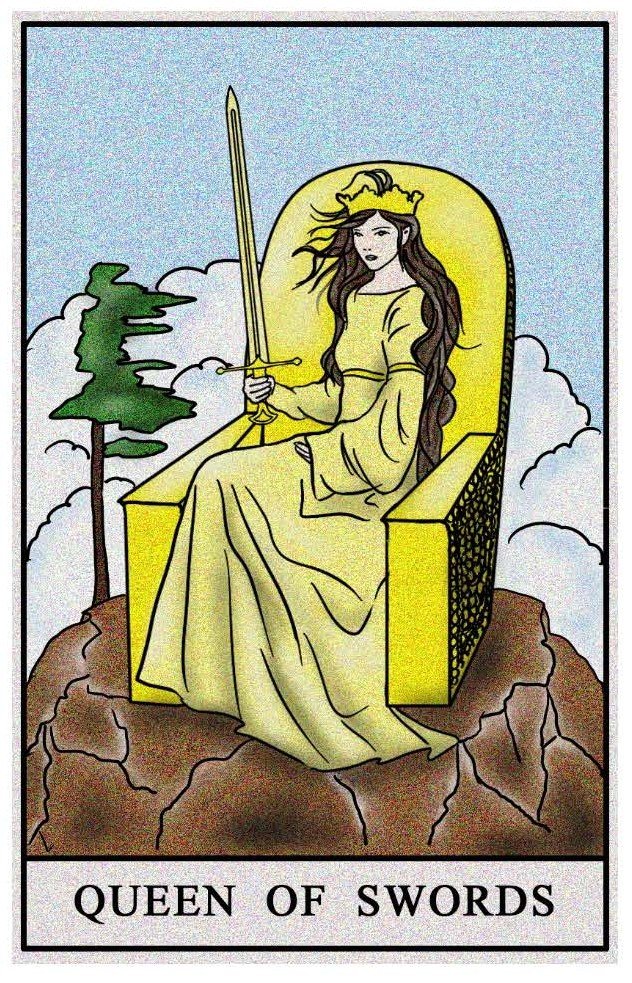 The Queen of Swords sits erect upon a cloud-adorned throne, one hand raised in greeting or command, the other holding her sword perfectly upright with practised ease. Her expression is clear-eyed, composed, and
entirely without sentimentality, not cold, but honest in the way that only someone who has known genuine loss and chosen clarity over bitterness can be. A butterfly adorns her crown. She has been through things.
She sees things clearly because of them, not in spite of them. As the water element of the air suit, the Queen of Swords brings emotional depth, intuitive perception, and hard-won wisdom to the intellectual and
communicative domain of swords, creating the archetype of someone whose emotional experience has refined rather than destroyed their capacity for clear, honest, and compassionate truth-telling. Associated with Libra
and Virgo, she combines analytical precision with genuine empathy in equal and perfectly calibrated measure. In a reading, the Queen of Swords represents someone of formidable intelligence, hard-won wisdom, and the
particular grace of someone who has suffered, understood their suffering, and emerged with both their clarity and their compassion intact. She does not deceive and she does not tolerate deception. As an energy to
embody, she asks you to speak your truth clearly and without apology, to make decisions with both your head and your lived experience, and to offer others the honest, direct, genuinely caring counsel that you
yourself would most want to receive.
The Queen of Swords sits erect upon a cloud-adorned throne, one hand raised in greeting or command, the other holding her sword perfectly upright with practised ease. Her expression is clear-eyed, composed, and
entirely without sentimentality, not cold, but honest in the way that only someone who has known genuine loss and chosen clarity over bitterness can be. A butterfly adorns her crown. She has been through things.
She sees things clearly because of them, not in spite of them. As the water element of the air suit, the Queen of Swords brings emotional depth, intuitive perception, and hard-won wisdom to the intellectual and
communicative domain of swords, creating the archetype of someone whose emotional experience has refined rather than destroyed their capacity for clear, honest, and compassionate truth-telling. Associated with Libra
and Virgo, she combines analytical precision with genuine empathy in equal and perfectly calibrated measure. In a reading, the Queen of Swords represents someone of formidable intelligence, hard-won wisdom, and the
particular grace of someone who has suffered, understood their suffering, and emerged with both their clarity and their compassion intact. She does not deceive and she does not tolerate deception. As an energy to
embody, she asks you to speak your truth clearly and without apology, to make decisions with both your head and your lived experience, and to offer others the honest, direct, genuinely caring counsel that you
yourself would most want to receive.
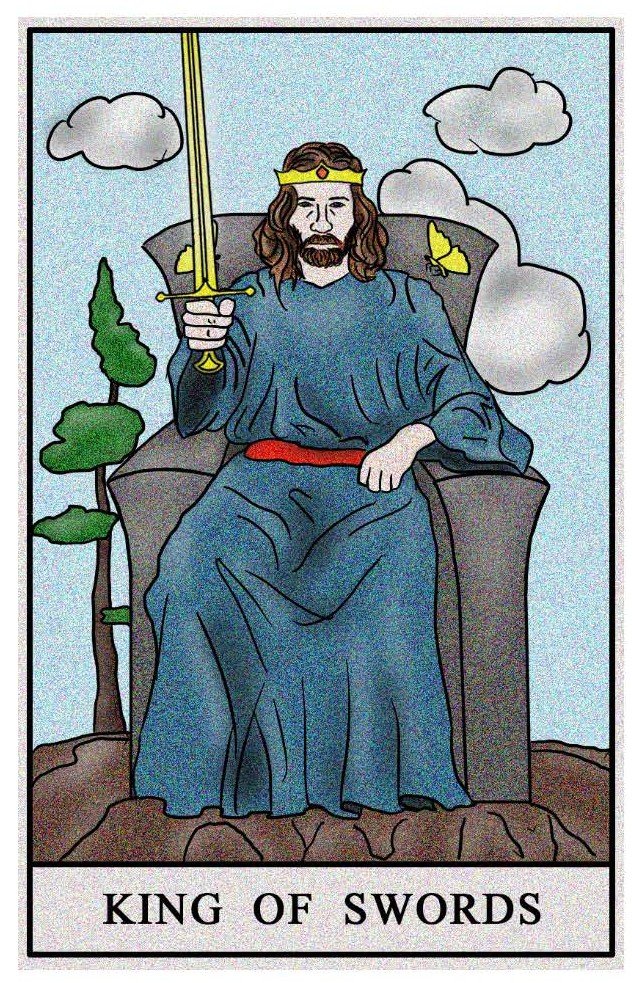 The King of Swords sits upon a stone throne, sword held perfectly upright in his right hand, his gaze direct and unwavering. He wears a blue robe beneath his purple cloak, his crown simple and unadorned by vanity.
Butterflies decorate his throne. The sky behind him holds both blue clarity and the suggestion of storm clouds, he governs in all weathers, applies the same clear judgment to sunshine and turbulence alike, and
expects no different standard from those he leads. As the air element of the air suit, the King of Swords is the most purely and completely intellectual card in the entire tarot, the embodiment of reason, analysis,
objectivity, and the commanding authority of a mind that has mastered its domain completely. Associated with Aquarius and the fixed air energy of pure, principled intellect, he rules through the force of his clarity
and the irrefutable quality of his judgment rather than through charisma or emotional appeal. In a reading, the King of Swords represents the highest expression of intellectual authority, someone who thinks with
extraordinary precision, communicates with absolute clarity, and makes decisions based on principle rather than sentiment, preference, or personal advantage. As a person in your life, he is the judge, the expert, the
impartial authority whose opinion carries genuine weight. As a quality to embody, he asks you to think more clearly, speak more precisely, and act from your highest principles even, especially, when doing so is
personally costly. The sword of truth serves justice, not comfort.
The King of Swords sits upon a stone throne, sword held perfectly upright in his right hand, his gaze direct and unwavering. He wears a blue robe beneath his purple cloak, his crown simple and unadorned by vanity.
Butterflies decorate his throne. The sky behind him holds both blue clarity and the suggestion of storm clouds, he governs in all weathers, applies the same clear judgment to sunshine and turbulence alike, and
expects no different standard from those he leads. As the air element of the air suit, the King of Swords is the most purely and completely intellectual card in the entire tarot, the embodiment of reason, analysis,
objectivity, and the commanding authority of a mind that has mastered its domain completely. Associated with Aquarius and the fixed air energy of pure, principled intellect, he rules through the force of his clarity
and the irrefutable quality of his judgment rather than through charisma or emotional appeal. In a reading, the King of Swords represents the highest expression of intellectual authority, someone who thinks with
extraordinary precision, communicates with absolute clarity, and makes decisions based on principle rather than sentiment, preference, or personal advantage. As a person in your life, he is the judge, the expert, the
impartial authority whose opinion carries genuine weight. As a quality to embody, he asks you to think more clearly, speak more precisely, and act from your highest principles even, especially, when doing so is
personally costly. The sword of truth serves justice, not comfort.

The Boston Tarot is the website of Dr. Elliot Voss, an internationally renowned astrologer/astrologist who has been studying the heavens, tarot, and numerology for over forty years.
© Copyright 2025, All Rights Reserved, Elliot Voss | terms & privacy