
The Tarot deck is a collection of symbolic cards used for reflection, insight, divination, and personal development. Most modern Tarot decks contain 78 cards divided into the 22 Major Arcana, which represent significant life lessons and archetypal experiences, and the 56 Minor Arcana, which explore everyday events, emotions, challenges, and opportunities. whilst Tarot is often associated with fortune-telling, many practitioners use the cards as tools for meditation, self-exploration, and creative inspiration.
Over the centuries, different Tarot decks have emerged as artists, occultists, and spiritual traditions have adapted the cards to reflect their own philosophies and aesthetics. Some decks preserve historical imagery, whilst others incorporate esoteric symbolism, mythology, astrology, psychology, or modern cultural themes. Although the artwork and interpretations may vary, most decks share a common structure that allows readers to transfer their knowledge from one deck to another. Understanding the most influential Tarot decks provides valuable insight into how the Tarot evolved and why different readers are often drawn to different styles of imagery and symbolism.
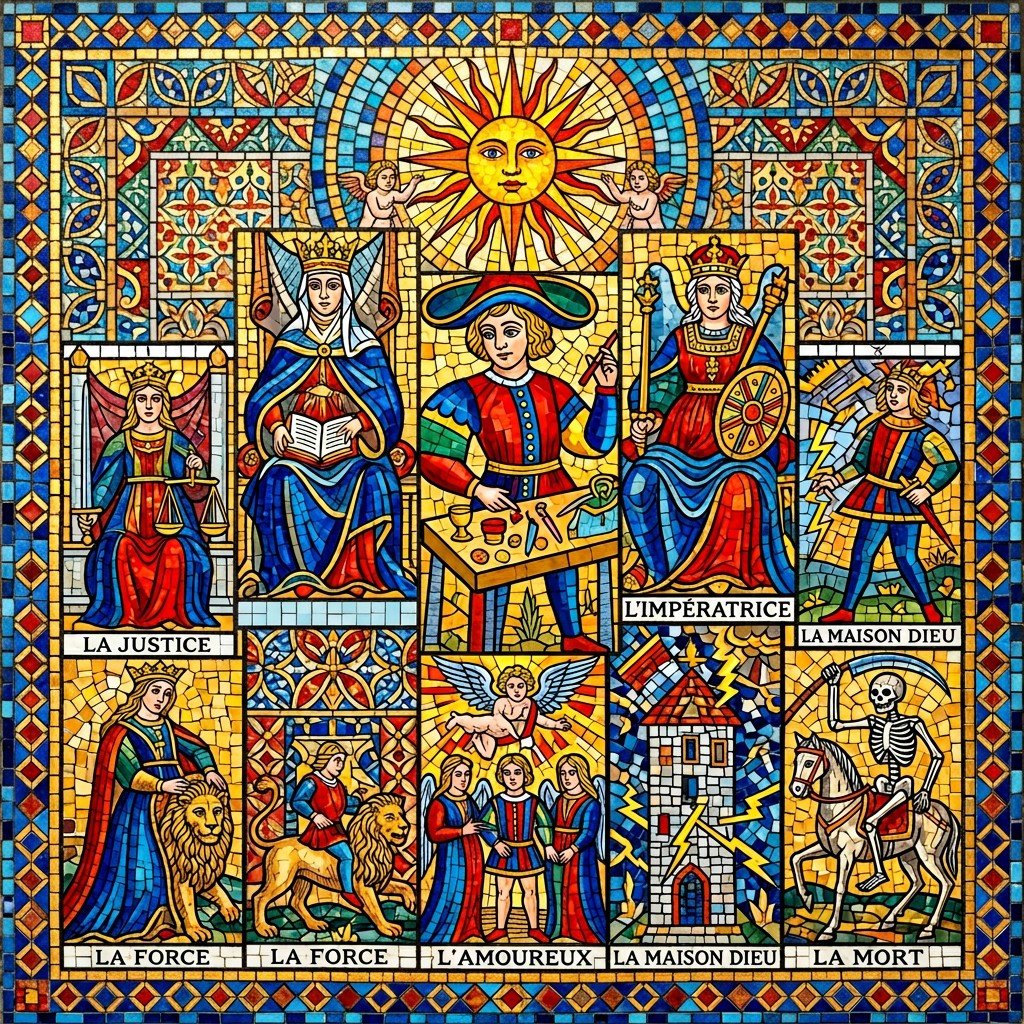 The Tarot de Marseille is one of the oldest
and most historically significant Tarot traditions. Originating in France during the seventeenth and eighteenth centuries, it is considered by many scholars to be the closest representation of the
early Tarot decks that evolved from Renaissance playing cards. The deck's name comes from the city of Marseille, where many influential card makers produced their versions of the Tarot.
The Tarot de Marseille is one of the oldest
and most historically significant Tarot traditions. Originating in France during the seventeenth and eighteenth centuries, it is considered by many scholars to be the closest representation of the
early Tarot decks that evolved from Renaissance playing cards. The deck's name comes from the city of Marseille, where many influential card makers produced their versions of the Tarot.
The artwork of the Tarot de Marseille is characterized by bold primary colors, simple line work, and highly stylized figures. Unlike many modern decks, the numbered Minor Arcana cards often lack detailed scenic illustrations. Instead, they display arrangements of cups, swords, wands, or coins, requiring readers to rely more heavily on numerology, symbolism, and intuition when interpreting the cards.
The Major Arcana cards contain imagery that has remained remarkably consistent for centuries, including iconic figures such as The Fool, The Magician, The Empress, and Death. Because of its historical roots, the Tarot de Marseille is highly valued by traditionalists and historians. Many contemporary readers appreciate the deck for its directness and flexibility, believing that its less prescriptive imagery encourages deeper personal interpretation and a stronger connection to the original Tarot tradition.
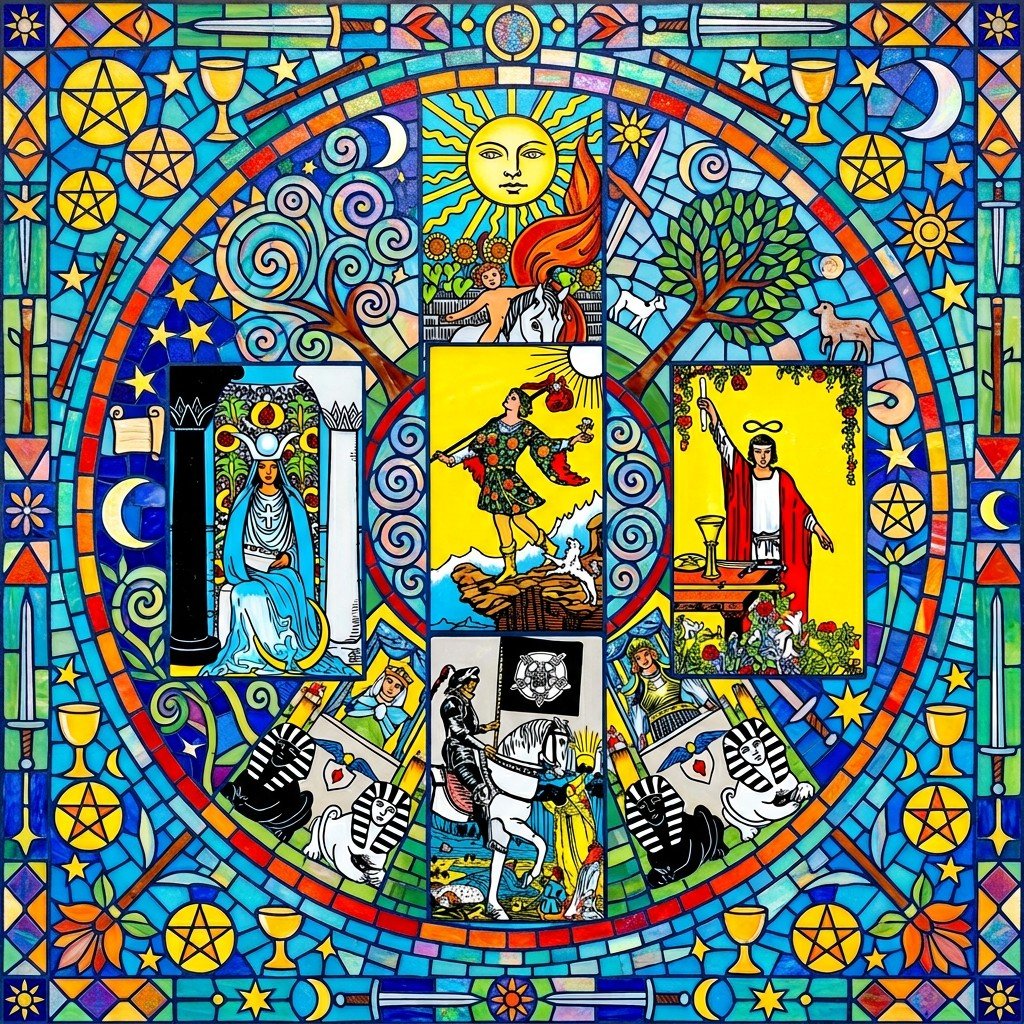 The Rider–Waite–Smith Tarot, first
published in 1909, is arguably the most influential Tarot deck in the modern world. Created by occult scholar Arthur Edward Waite and illustrated by Pamela Colman Smith, the deck was published by
the Rider Company in London and quickly became the foundation for countless modern Tarot designs.
The Rider–Waite–Smith Tarot, first
published in 1909, is arguably the most influential Tarot deck in the modern world. Created by occult scholar Arthur Edward Waite and illustrated by Pamela Colman Smith, the deck was published by
the Rider Company in London and quickly became the foundation for countless modern Tarot designs.
One of the deck's most revolutionary features was the decision to fully illustrate all seventy-eight cards, including the Minor Arcana. Rather than showing simple arrangements of suit symbols, each card depicts a complete scene filled with symbolic meaning. This innovation made the Tarot more accessible to beginners and helped readers develop intuitive interpretations based on visual storytelling.
The Rider–Waite–Smith deck incorporates a rich blend of Christian symbolism, Western esotericism, mysticism, Kabbalah, astrology, and folklore. Many of the card meanings commonly taught today originate from this deck and Waite's accompanying guidebook. Because of its widespread popularity and influence, most contemporary Tarot books, courses, and online resources are based either directly or indirectly on the Rider–Waite–Smith system. For many readers, it remains the standard against which all other Tarot decks are measured.
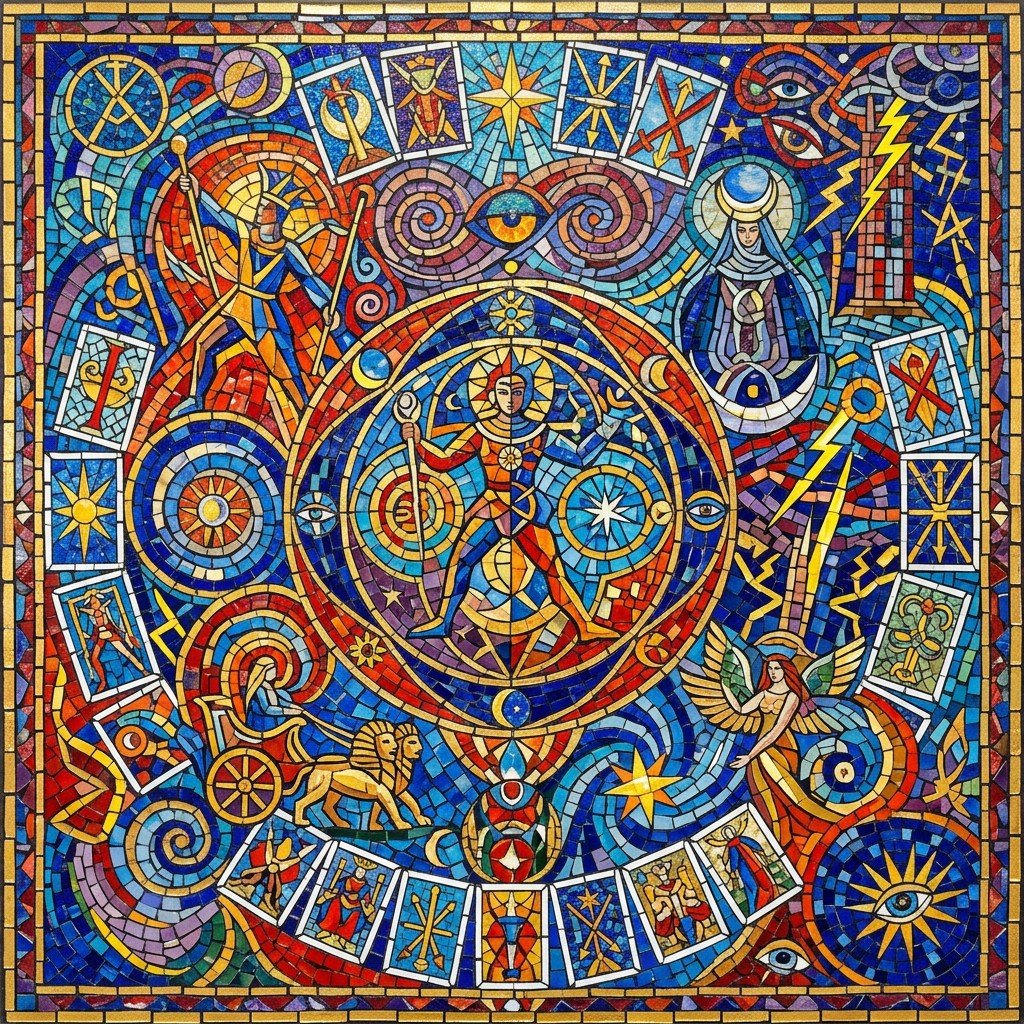 The Thoth Tarot was created by the British occultist Aleister Crowley
and painted by artist Lady Frieda Harris between 1938 and 1943. Although it was completed during the Second World War, the deck was not widely published until years after Crowley's death. Today it
is regarded as one of the most sophisticated and symbolically complex Tarot systems ever produced.
The Thoth Tarot was created by the British occultist Aleister Crowley
and painted by artist Lady Frieda Harris between 1938 and 1943. Although it was completed during the Second World War, the deck was not widely published until years after Crowley's death. Today it
is regarded as one of the most sophisticated and symbolically complex Tarot systems ever produced.
The Thoth deck reflects Crowley's spiritual philosophy known as Thelema and incorporates extensive references to astrology, alchemy, Kabbalah, sacred geometry, Egyptian mythology, and ceremonial magic. Every card is layered with symbolic correspondences, making the deck particularly appealing to readers who enjoy studying esoteric traditions in depth.
Visually, the Thoth Tarot differs dramatically from both the Tarot de Marseille and the Rider–Waite–Smith deck. Harris's artwork is vibrant, abstract, and dynamic, often emphasizing energy, movement, and spiritual transformation rather than literal scenes. Several card names and interpretations were also modified to align with Crowley's teachings.
Whilst the Thoth Tarot can be more challenging for beginners, many experienced readers consider it one of the most intellectually rich Tarot decks available. Its intricate symbolism rewards long-term study and offers multiple layers of meaning that continue to inspire Tarot practitioners, occult scholars, and spiritual seekers around the world.

The Boston Tarot is the website of Dr. Elliot Voss, an internationally renowned astrologer/astrologist who has been studying the heavens, tarot, and numerology for over forty years.
© Copyright 2025, All Rights Reserved, Elliot Voss | terms & privacy