
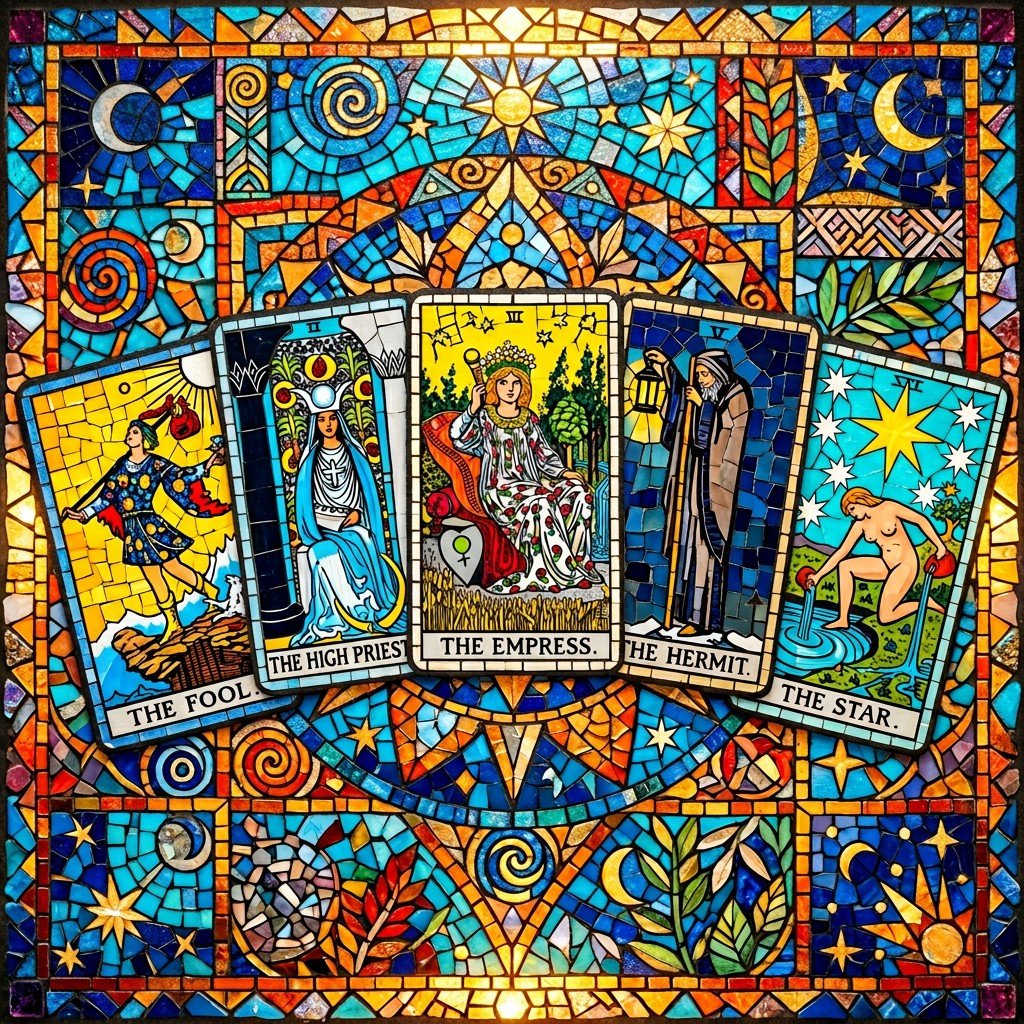
 The history of tarot is a story of transformation, from aristocratic parlour game to instrument of divination, from hand-painted luxury object to mass-produced spiritual tool
used by millions worldwide. It spans six centuries and crosses the boundaries of art, religion, commerce, and occultism.
The history of tarot is a story of transformation, from aristocratic parlour game to instrument of divination, from hand-painted luxury object to mass-produced spiritual tool
used by millions worldwide. It spans six centuries and crosses the boundaries of art, religion, commerce, and occultism.
The earliest tarot cards appeared in northern Italy in the first half of the 15th century, most likely between the 1420s and 1440s. They were not created for mystical purposes. The first tarot decks, known as tarocchi, were commissioned by wealthy Italian noble families as elaborate card games. The Visconti and Sforza families of Milan were among the most prominent patrons, and several surviving decks from this period bear their names. These early cards were extraordinary objects: hand-painted on vellum or heavy card, often gilded, and produced by skilled artists. They bore little resemblance to the mass-produced decks of later centuries and were far beyond the reach of ordinary people.
The game played with these cards, also called tarocchi, was a trick-taking game not unlike bridge. The additional trump cards, what we now call the Major Arcana, functioned as a higher-ranking suit that could beat the standard four suits. The game spread rapidly through northern Italy and into France, where it became known as tarot, and later into other parts of Europe. For the better part of three centuries, this remained the primary use of tarot cards: they were a game, nothing more.
The decisive shift toward tarot's association with divination came in the late 18th century, almost entirely through the influence of French occultists. In 1781, the Swiss clergyman and Freemason Antoine Court de Gébelin published an influential essay claiming that tarot was not a European invention at all, but a survival of ancient Egyptian wisdom, a sacred book encoded in card form and brought to Europe by the Roma people. This claim was almost entirely fabricated, unsupported by any historical evidence, but it captured the imagination of an era deeply fascinated by the ancient and the esoteric. It transformed how Europeans thought about tarot almost overnight.
Building on de Gébelin's ideas, a French cartomancer known as Etteilla produced the first deck specifically designed for divination in 1789, assigning explicit divinatory meanings to each card and reshaping some of the imagery accordingly. The occult reinterpretation of tarot deepened through the 19th century, with French esotericists such as Éliphas Lévi connecting the cards to Kabbalah, numerology, and astrology, weaving tarot into a grand unified system of Western occultism.
The most consequential development in tarot's modern history came in 1909, when Arthur Edward Waite and artist Pamela Colman Smith, both members of the Hermetic Order of the Golden Dawn, produced the Rider-Waite-Smith deck. For the first time, every single card, including the 56 Minor Arcana, featured fully illustrated scenes rather than simple arrangements of suit symbols. This made the cards dramatically more accessible and interpretively rich. The Rider-Waite-Smith deck became the template against which virtually all subsequent decks have been measured, and it remains the best-selling tarot deck in the world.
Through the 20th century, tarot expanded beyond occult circles into broader popular culture, particularly during the countercultural movements of the 1960s and 1970s. Today it occupies a remarkable cultural position, taken seriously by millions as a genuine spiritual or psychological tool, studied academically as an art historical artefact, and engaged with casually by many more as a means of self-reflection.

The Boston Tarot is the website of Dr. Elliot Voss, an internationally renowned astrologer/astrologist who has been studying the heavens, tarot, and numerology for over forty years.
© Copyright 2025, All Rights Reserved, Elliot Voss | terms & privacy